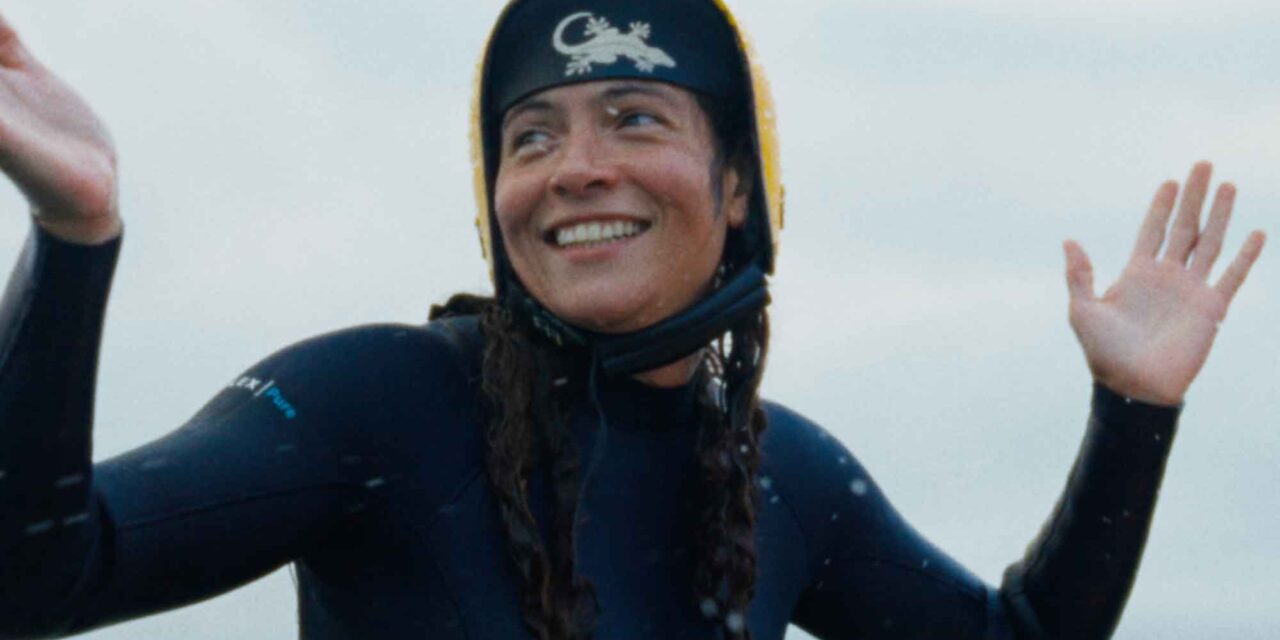

Photo: Language of Water
Language of Water
What does it mean to experience the world through sound — or without it? Language of Water from Director Joya Berrow and writer / producer Bellaray Bertrand-Webb is a beautiful and intimate portrait of her sister Lily Bertrand-Webb as their family trace her journey from losing her hearing at two to receiving a cochlear implant at nine and surfing without sound. Together, the two sisters explore the very notion of sound and discover the bittersweet limits of capturing another person’s lived experience.
“Sound is memory and emotion. It reaches me through my body, through the water, through the people who move with me. Colour is sound. Texture is sound. Touch is sound. Sight is sound. That’s my sound,” Surfer and professional photographer Lily Bertrand-Webb.
Winner of the Women of the Sea Film Fund presented by Finisterre, Language of Water makes its world premiere at the 15th Edition of London Surf / Film Festival on Saturday 7th November. Tickets here Ahead of this very special screening, Demi Taylor spoke with Lily and filmmakers Joya Berrow and Bellaray Bertrand-Webb to learn more about the project.
Photo: Language of Water
Can you tell us about the idea behind the film and what made you want to tell this story now?
Bellaray: Lily told me a story about something profound that happened between her and a stranger in the sea and I became curious about my sister’s experience in the water, what might it be like to swim and surf without her cochlear on, and so without sound. This led to more questions. I wanted to explore deeper, to grasp how exactly she experienced sound, from losing her hearing at two, to her cochlear implant operation.It’s a deeply personal tale. As a writer and sibling how did you navigate what is not just a story about Lily but also a story exploring your relationship as sisters?
Bellaray: I have come to realise it is an impossible task to try and experience someone else’s sense, because of how differently each of us experience life through all our senses, it’s beyond words and images. Making the film has been beautiful, eye opening, and exposing, I didn’t realise it would feel this raw and challenging, to explore our family and the passage of time through archive photos, the hospital reports, the interviews and how much I was asking of my sister, to open up and really delve deep, but it was worth it. It’s been like therapy but also ensured my real therapist isn’t getting fired any time soon!The notion of sound is vast and this film is both intimate and far-reaching. How did you tell such a big story with such a light touch and in such a focussed way?
Joya: It’s a big and profound question, “What is sound?” We tried to bring the audience into their senses and ask them this question. When we were asking Lily to describe what is sound and she said to us. “I don’t know, you tell me.” And we couldn’t. This made us really dive into the subjectivity of sound and how creatively that could be explored. It’s often the way with storytelling that the more macro and intimate you go, the more you see these small details become huge universal themes. We were really focused on telling Lily and Bellaray’s story of sisterhood as this was the seed of the whole idea, then came recalling memories, the film became the process of understanding each other, the family as a whole sharing stories too from different perspectives. Hopefully everyone can connect and see their own family, friends and loved ones in these characters as we navigate life together.
Photo: Language of Water
The film has a very distinctive aesthetic, can you tell us a little bit about it, why you chose to shoot on film and how it has helped to shape this story.
Joya: We shot on an old Bolex, on 100ft rolls of 250D Kodak over a few shoots in Cornwall and London. This camera does not record sound, so all the sound you hear in the film has been recreated and this felt very intentional given the subject matter. Lily also shoots on analogue formats so it felt aligned that we would also. 16mm has a very human, tactile texture to it and it really suits the intimacy of the subject matter. A lot of the time it was just Lily and I with the camera and that was really special to be so candid and creative with each other.
Photo: Lily Bertrand-Webb
How did it feel exploring key moments of your life on film? Have you learnt anything about yourself?
Lily: It was very strange at first to be the one being looked at, when I’m usually the one behind the camera. Over six years I came to see how much of my life I’d been communicating through images without quite realising it. Being filmed swimming and floating with my eyes shut was challenging. When I can’t hear or see, I’m completely closed off.
Photo: Language of Water
It suddenly dawned on me that I really can’t see or hear when I’m in the water. When I swim underwater or get wiped out, I shut my eyes completely. I’m in the water in complete darkness.
Photo: Language of Water
I also realised through this film that it hadn’t dawned on many people that I surf and swim without sound. I hadn’t realised how much I’d taken that for granted myself until I saw it through their eyes.What drew you to the ocean as a child, and what has kept you engaged with it as a woman and now as a mother?
Lily: I can’t remember a time before I knew the sea. I have vivid memories of learning to surf with my dad, and of playing on the beach with my sister, building sandcastles and, let’s be honest, eating a fair bit of sand! The water has always been a place where I feel content, wild, untouchable, real, present and alive. As I’ve grown, it has become more thrilling. I’m very aware of how powerful and dangerous the sea can be if you don’t know it, so I’m more nervous going in on my own now. I’d rather have a companion who can be my ears.
Photo: Language of Water
Becoming a mother has added a whole new meaning. Now when I’m in the water, I’m thinking about him as much as myself, and I’m excited to share the sea with him as he grows. I’m also even more hypervigilant now. I’ve been taking him to swimming lessons, and my focus is entirely on him, watching every movement and listening with my whole body.
Photo: Language of Water
What preconception about deafness do you hope people leave behind? What do you hope they take away?
Lily: I hope people let go of the idea that deafness is an absence or a loss of something. I used to be asked whether I could do certain things, and people were often surprised that I could play the piano, for example. I hope they leave with a sense that there are many ways to experience the world, and that listening and understanding can happen through other senses: sight, touch, the body and the sea.
Photo: Language of Water
15th Edition London Surf / Film Festival x Finisterre touches down 5-7 November 2026 hosted at the iconic Riverside Studios. Serving up 3 nights of the ultimate in cinematic surf inspiration - travel to stir the wanderlust, documentaries to inspire, plus cinematography, stories and surfing that redefine the bounds of possibility – all accompanied by talks, icons, change, culture, community good times and more, you don’t want to miss this. londonsurffilmfestival.com